
Homemade Cinnamon Rolls Recipe: Step-by-Step Guide for Fluffy, Gooey Rolls
TL;DR / Quick Summary: An authentic, bakery-quality cinnamon roll requires an enriched yeast dough (500 g bread flour or all-purpose flour, 250 ml warm milk, 7 g instant yeast or 21 g fresh yeast, 75 g softened butter, 70 g sugar, 1 egg), a brown sugar and cinnamon filling (90 g butter, 100 g brown sugar, 2–3 tbsp Ceylon cinnamon), and a velvety cream cheese frosting. For bakery-level gooey centers, pour 60 to 80 ml of warm heavy cream over the proofed rolls right before baking at 180 °C (350 °F) for 22 to 25 minutes.
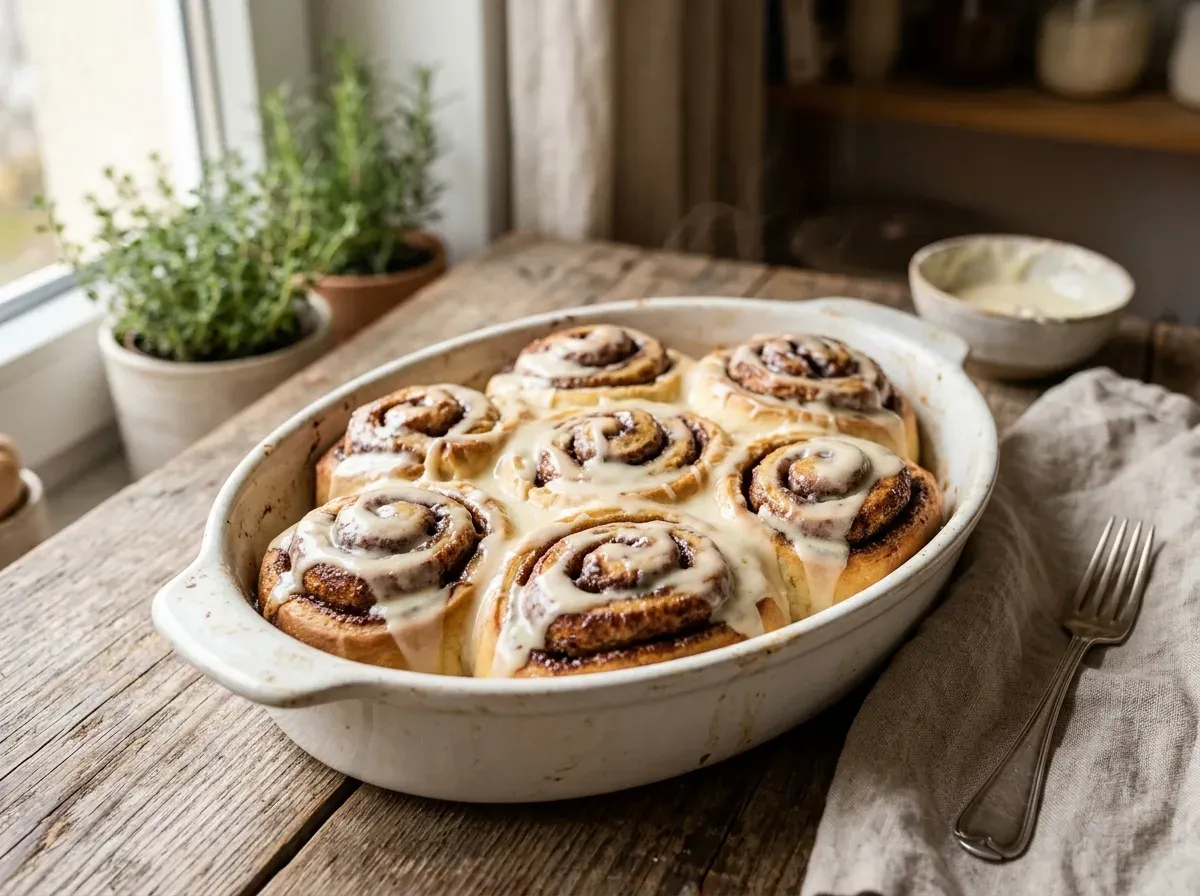
How do you make cinnamon rolls fluffy and gooey instead of dry?
Cinnamon rolls turn out pillowy soft and gooey by maintaining high dough hydration, incorporating sufficient milk fat and butter, and avoiding prolonged baking beyond 25 minutes at 180 °C (350 °F). Dry, dense cinnamon rolls are almost always caused by adding excessive flour during kneading, activating yeast in overheated milk, or overbaking.
To guarantee bakery-style softness every time, follow these core food science principles:
- Gluten Relaxation & Fat Coating: Enriched doughs contain butter, egg, and whole milk, which coat gluten strands and inhibit tough gluten matrices from forming, keeping the crumb soft and tender.
- The Warm Heavy Cream Secret: Pouring ¼ cup (60 ml) of warm heavy cream between the risen rolls before sliding them into the oven creates steam and caramelizes into a moist bottom custard layer.
- Dark Brown Sugar Moisture: Brown sugar contains natural hygroscopic molasses, which attracts moisture and prevents the butter-cinnamon filling from drying out while baking.
[CTA / Internal Link: Convert US Cups and Sticks to exact grams for baking -> /calculator/grams-to-cups/]
What ingredients do you need for 12 classic cinnamon rolls? (Grams vs. Cups)
For 12 large homemade cinnamon rolls, you need 500 grams of flour (bread flour or all-purpose), 250 ml whole milk, 7 grams instant dry yeast (or 21 grams fresh yeast), 75 grams softened unsalted butter, 70 grams granulated sugar, 1 medium egg, and a filling of 90 grams butter, 100 grams brown sugar, and 15 grams ground cinnamon.
Volume measurements like American cups and tablespoons vary significantly based on how tightly an ingredient is scooped. For instance, 1 cup of flour can weigh between 120 g and 140 g, which easily throws off your dough hydration. Use the precise metric and US measurement table below:
Ingredient & Measurement Breakdown for 12 Rolls
| Dough Element | Ingredient | Metric Weight | US Customary Units | Baker’s Percentage |
|---|---|---|---|---|
| Yeast Dough | All-Purpose / Bread Flour | 500 g | ~ 4 cups (spooned & leveled) | 100 % |
| Yeast Dough | Whole Milk (lukewarm, 95 °F / 35 °C) | 250 ml (258 g) | 1 cup + 1 tbsp | 51.6 % |
| Yeast Dough | Instant Dry Yeast (or Fresh Yeast) | 7 g dry / 21 g fresh | 1 packet (2¼ tsp) / ½ cake | 1.4 % (Dry) / 4.2 % (Fresh) |
| Yeast Dough | Unsalted Butter (softened) | 75 g | ⅓ cup (5.3 tbsp) | 15.0 % |
| Yeast Dough | Granulated White Sugar | 70 g | ⅓ cup | 14.0 % |
| Yeast Dough | Large Egg (room temperature) | 1 egg (~ 50 g) | 1 large egg | 10.0 % |
| Yeast Dough | Salt & Ground Cardamom | 4 g salt / 1 tsp cardamom | ¾ tsp salt / 1 tsp cardamom | 0.8 % |
| Filling | Unsalted Butter (softened) | 90 g | 6.3 tbsp (~ ¾ stick) | 18.0 % |
| Filling | Brown Sugar (packed) | 100 g | ½ cup packed | 20.0 % |
| Filling | Ground Cinnamon (Ceylon preferred) | 15 g | 2 to 3 rounded tbsp | 3.0 % |
| Filling (Pro Tip) | Cornstarch (prevents leaks) | 5 g | 1 tsp | 1.0 % |
| Frosting | Full-Fat Cream Cheese | 100 g | ½ cup (3.5 oz) | 20.0 % |
| Frosting | Unsalted Butter (softened) | 40 g | 2.8 tbsp | 8.0 % |
| Frosting | Powdered Sugar (sifted) | 80 g | ⅔ cup | 16.0 % |
| Frosting | Pure Vanilla Extract | 1 tsp (5 ml) | 1 tsp | 1.0 % |
How do you convert fresh yeast to dry yeast for cinnamon rolls?
Fresh yeast converts to active dry or instant yeast at a 3:1 ratio by weight: 21 grams of fresh cake yeast equals exactly 7 grams of dry yeast (one standard commercial packet). Instant yeast can be mixed directly with dry ingredients, whereas active dry yeast and fresh yeast should first be dissolved in warm milk (32–37 °C / 90–98 °F).
Always watch liquid temperature closely when baking enriched yeast doughs:
- Optimal Proofing Window: 30 °C to 35 °C (86 °F to 95 °F). Yeast cells reproduce and ferment sugar rapidly.
- Thermal Destruction Threshold: Temperatures over 43 °C (110 °F) deactivate yeast enzymes, and temperatures above 49 °C (120 °F) kill the yeast completely.
- Conversion Formula:
Dry Yeast (g) = Fresh Yeast (g) ÷ 3
Fresh Yeast (g) = Dry Yeast (g) × 3
[CTA / Internal Link: Read the complete Fresh Yeast to Dry Yeast Conversion Guide -> /blog/convert-fresh-yeast-to-dry-yeast/]
How do you roll and cut cinnamon rolls cleanly without squishing them?
The cleanest method to slice cinnamon rolls is using unwaxed dental floss or kitchen twine instead of a chef’s knife. A knife’s downward pressure compresses the soft, laminated dough layers, squeezing the butter-sugar filling outward and turning round spirals into flat ovals.
Follow these 4 steps for picture-perfect rolls:
- Roll your rested dough into a uniform 16 × 12 inch (40 × 30 cm) rectangle approximately ¼-inch (5 mm) thick.
- Spread the softened butter from edge to edge, leaving a narrow ½-inch clean margin along one long side. Press the cinnamon-sugar evenly into the butter.
- Roll the rectangle tightly starting from the long side, pinching the final seam to secure the roll.
- Slide a 12-inch piece of thread underneath the dough log, cross the two ends over the top, and pull firmly in opposite directions. The thread slices cleanly through the dough without distorting its cylindrical shape.

Scale Baking Recipes & Convert Units Anywhere
Download the Kitchen Converter app for iOS and Android. Accurate pan resizing, yeast conversions, and cups-to-grams measurements 100% offline.
Can you prepare cinnamon rolls overnight in the refrigerator?
Yes, cinnamon rolls are ideally suited for an overnight cold proof in the refrigerator. Assemble, slice, and place the rolls in your buttered baking dish the evening before, cover tightly with plastic wrap, and refrigerate for 8 to 14 hours at 4 °C to 6 °C (39 °F to 43 °F).
Cold retardation slows down yeast gas production while allowing bacterial enzymes to break down starches into complex sugars. This results in a noticeably richer, buttery flavor profile and superior oven spring when baked in the morning.
Morning Baking Routine:
- Pull the baking dish out of the fridge and let it rest on the counter for 30 to 45 minutes to take off the chill and finish proofing.
- Drizzle with ¼ cup warm heavy cream over the rolls.
- Bake in a preheated oven at 180 °C (350 °F) for 22 to 25 minutes until golden brown.
[CTA / Internal Link: Convert Fahrenheit to Celsius for Baking Recipes -> /blog/fahrenheit-in-celsius-backen/]
Which frosting is best for cinnamon rolls (Cream Cheese vs. Sugar Glaze)?
The gold standard for American-style cinnamon rolls is a cream cheese frosting made with cream cheese, unsalted butter, confectioners’ sugar, and vanilla extract. The mild acidity of cultured cream cheese cuts through the rich butter and sugar filling, preventing the rolls from tasting cloying.
Frosting & Glaze Comparison
| Glaze Style | Key Ingredients | Flavor Profile | Texture | Best Paired With |
|---|---|---|---|---|
| Cream Cheese Icing | 100 g cream cheese, 40 g butter, 80 g powdered sugar | Tangy, rich, velvety vanilla | Melts into crevices on warm rolls | Bakery-style American cinnamon rolls |
| Classic Vanilla Glaze | 120 g powdered sugar, 2 tbsp milk, vanilla | Sweet, light, clean | Sets into a crisp, delicate shell | Traditional European bakery buns |
| Scandinavian Pearl Sugar | Egg wash, Swedish pearl sugar nibs | Mild sweetness, toasted | Crunchy exterior bite | Cardamom Kanelbullar buns |
| Salted Caramel Glaze | Caramel sauce, butter, sea salt flakes | Deep toffee, buttery, salty | Thick and decadent drizzle | Pecan or holiday dessert rolls |
Step-by-Step Instructions: How to Make Homemade Cinnamon Rolls
Making cinnamon rolls involves five straightforward steps: kneading the enriched yeast dough (10 min), first rise (60 min), rolling and slicing with string (15 min), second pan proof (30 min), and baking at 180 °C (350 °F) for 22 to 25 minutes.
1. Knead the Dough
Warm milk to 35 °C (95 °F) and dissolve yeast with 1 tsp of sugar. In a stand mixer fitted with the dough hook, combine flour, remaining sugar, salt, ground cardamom, egg, softened butter, and yeast milk. Knead on medium-low speed for 8 to 10 minutes until the dough is elastic, smooth, and clears the sides of the bowl.
2. First Bulk Rise
Transfer the dough ball to a lightly oiled bowl, cover with a damp cloth, and let rise in a warm, draft-free spot for 60 to 75 minutes until doubled in size.
3. Assemble and Roll
Mix softened butter, brown sugar, cinnamon, and cornstarch into a smooth paste. Roll the dough on a lightly floured surface into a 16 × 12 inch (40 × 30 cm) rectangle. Spread the cinnamon butter mixture evenly across the dough. Roll tightly from the long edge into a log.
4. Slice and Second Rise
Using dental floss or kitchen twine, slice the roll into 12 equal rounds (approx. 1.25 inches / 3 cm thick). Arrange in a buttered 9 × 13 inch (23 × 33 cm) ceramic or metal baking pan. Cover and let rise for 30 minutes until puffy and touching.
5. Bake and Frost
Optionally pour 60 ml of warm heavy cream over the buns. Bake at 180 °C (350 °F) conventional heat for 22 to 25 minutes until light golden brown on top. Whisk cream cheese, butter, powdered sugar, and vanilla until fluffy, then spread generously over the warm rolls straight out of the oven.
[CTA / Internal Link: Convert Springform and Baking Pan Dimensions -> /blog/casserole-dish-conversion-guide/]
Frequently Asked Questions (FAQ)
Why are my cinnamon rolls dense or tough?
Cinnamon rolls become dense when either too much flour is incorporated during kneading or the dough was under-proofed before baking. Keep the dough slightly tacky to the touch rather than stiff, knead for a full 8 to 10 minutes to develop the gluten structure, and ensure the rolls double in size before going into the oven.
What flour makes the softest cinnamon rolls: All-Purpose or Bread Flour?
Bread flour produces the highest rise and chewiest, bakery-style texture because its 12–14% protein content provides structural support for heavy butter and sugar. All-purpose flour (10–11% protein) also works well, resulting in an exceptionally tender, cake-like crumb.
How do you store cinnamon rolls to keep them soft for days?
Store cooled cinnamon rolls in an airtight container at room temperature for up to 2 days, or in the refrigerator for up to 5 days if frosted with cream cheese. To restore their freshly baked softness, microwave an individual roll for 15 to 20 seconds before serving.
Can you freeze cinnamon rolls before or after baking?
Yes, cinnamon rolls freeze exceptionally well. You can freeze unbaked shaped rolls in the pan right after cutting; thaw overnight in the fridge and give them a 45-minute room-temperature rise before baking. Alternatively, freeze baked rolls without frosting for up to 3 months, then warm in a 160 °C (325 °F) oven for 10 minutes.
How do I accurately convert US cinnamon roll recipes from cups to grams?
Because 1 cup of flour weighs 120 grams while 1 cup of packed brown sugar weighs 200 grams, volume cups do not translate with a single flat ratio. Use a digital kitchen scale for precision, or rely on the free Kitchen Converter app to instantly calculate exact weights from international baking recipes.