
Authentic Neapolitan Pizza Dough Recipe: Baker’s Percentages & Guide
TL;DR / Quick Summary: An authentic Neapolitan pizza dough consists of 100% wheat flour (preferably Italian Tipo 00 with a W rating of 280–320), 60–65% hydration (water), 2.5–3% salt, and only 0.1–0.2% fresh yeast undergoing a cold fermentation (24–48 hours in the refrigerator). For 4 pizza dough balls (250 g each), you need exactly 600 g Tipo 00 flour, 375 g cold water, 16 g salt, and 1 g fresh yeast (or 0.33 g dry yeast). Long fermentation ensures optimal digestibility, rich flavor, and a light, airy crust with signature leopard spotting.
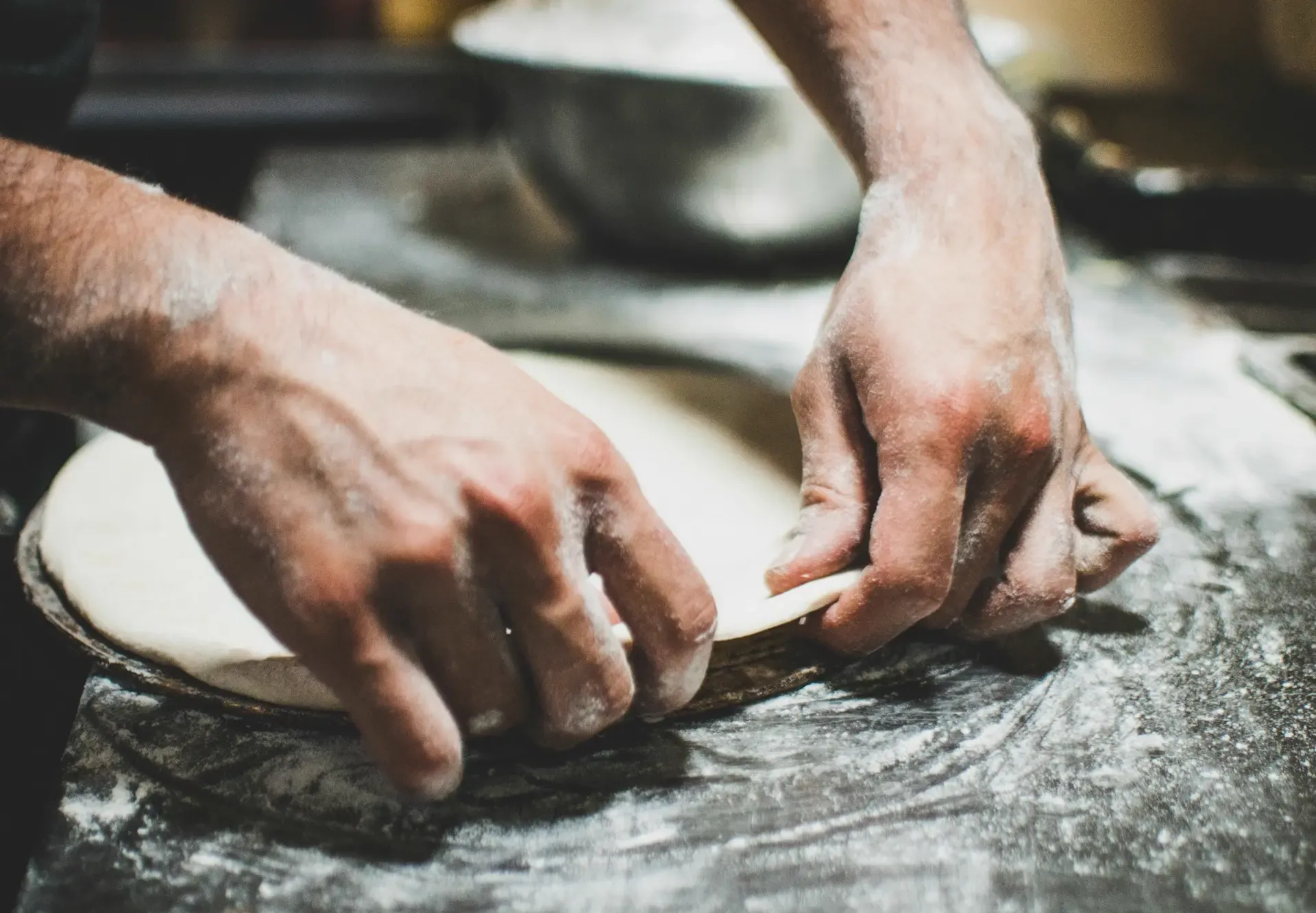
What Makes Authentic Neapolitan Pizza Dough Work?
Authentic Neapolitan pizza dough succeeds through a precise combination of high-protein flour (Tipo 00), controlled water ratio (60–70% hydration), minimal yeast dosage, and extended fermentation time. At cold refrigerator temperatures, enzymes break starch down into simple sugars while a strong gluten matrix traps carbon dioxide, creating characteristic airy crust bubbles (cornicione).
Unlike quick emergency doughs, traditional Neapolitan dough relies on patience and baker’s percentages. By keeping yeast below 0.2% relative to total flour weight, the dough ferments slowly over 24 to 72 hours. This process breaks down complex carbohydrates, resulting in an exceptionally digestible dough that inflates rapidly when baked at high heat (above 800°F / 425°C).
Which Flour is Best for Pizza Dough (Tipo 00 vs. All-Purpose vs. Bread Flour)?
The gold standard for Neapolitan pizza dough is Italian Tipo 00 flour with a protein content of 12.5% to 14% and a strength rating of W 280 to W 320. High-protein bread flour serves as a reliable alternative for hydrations up to 65%, while standard All-Purpose flour contains less protein and breaks down faster during long cold fermentation.
Protein content (specifically glutenin and gliadin) determines how much water the dough can absorb and how elastic the gluten structure becomes. The W index measures gluten strength. A high W rating (W 280–320) allows the dough to withstand 24 to 72 hours of cold fermentation without losing structural integrity.
Flour Comparison Table for Pizza Dough
| Flour Type | Protein Content | W Rating (Strength) | Water Absorption | Recommended Fermentation | Best Use Case |
|---|---|---|---|---|---|
| Tipo 00 (Pizza / Farina) | 12.5% – 14.5% | W 280 – W 320 | High (65% – 75%) | 24 to 72 hours | Neapolitan Pizza (Ooni, Pizza Stone) |
| Bread Flour (High Gluten) | 12.0% – 13.5% | W 240 – W 280 | Medium-High (62% – 67%) | 12 to 24 hours | New York Style, Pan Pizza |
| All-Purpose Flour | 9.5% – 11.0% | W 160 – W 200 | Low (55% – 60%) | 2 to 6 hours | Quick Sheet-pan Pizza |
| Whole Wheat / Spelt | 12.0% – 13.5% | W 200 – W 240 | High (65% – 70%) | 8 to 12 hours | Whole Grain Alternative |
How Much Water, Yeast, and Salt Do You Need Per 1 kg of Flour (Baker’s Percentages)?
Professional pizza bakers calculate all ingredient weights relative to total flour weight (100%) using baker’s percentages. For 1,000 grams of flour, the standard ratio requires 600 to 650 grams of water (60–65% hydration), 25 to 30 grams of salt (2.5–3%), and 0.5 to 2 grams of fresh yeast (0.05–0.2%) depending on fermentation time.
Baker’s percentages allow effortless scaling for any desired quantity or dough ball count.
Recipe Scaling Table by Dough Balls (250 g per ball)
The table below details exact ingredient weights for standard 250 g dough balls (ideal for 12-inch / 30 cm pizzas):
| Dough Balls (250 g each) | Flour (100%) | Water (62.5% Hydration) | Salt (2.6%) | Fresh Yeast (24h Cold Ferment) | Active Dry Yeast (Alternative) |
|---|---|---|---|---|---|
| 2 Balls (500 g dough) | 300 g | 188 g (ml) | 8 g | 0.5 g | 0.17 g |
| 4 Balls (1,000 g dough) | 600 g | 375 g (ml) | 16 g | 1.0 g | 0.33 g |
| 6 Balls (1,500 g dough) | 900 g | 563 g (ml) | 23 g | 1.5 g | 0.50 g |
| 8 Balls (2,000 g dough) | 1,200 g | 750 g (ml) | 31 g | 2.0 g | 0.67 g |

Convert Baker's Percentages & Grams to Cups
Instantly convert flour, hydration, yeast, and grams into US Cups or spoons with the free Kitchen Converter.
Dry Yeast vs. Fresh Yeast: How Do You Convert Yeast Amounts for Pizza Dough?
Fresh cake yeast can be substituted with active dry yeast or instant dry yeast at a 3:1 ratio. 3 grams of fresh yeast equals exactly 1 gram of active dry yeast. For a 1 kg flour pizza dough undergoing a 24-hour cold ferment, use approximately 1 g fresh yeast or 0.33 g instant dry yeast. A precision jeweler’s scale ensures accurate measurement.
Because standard kitchen scales struggle with fractions of a gram, you can dissolve a known yeast amount (e.g., 1 gram) in warm water and measure out the corresponding portion of liquid.
- Fresh Yeast to Dry Yeast Formula:
Gram Dry Yeast = Gram Fresh Yeast ÷ 3 - Dry Yeast to Fresh Yeast Formula:
Gram Fresh Yeast = Gram Dry Yeast × 3
How Does Cold Fermentation Work (24h to 72h Retardation)?
Cold fermentation (retardation) slows yeast metabolic activity at 39°F to 43°F (4°C to 6°C) while enzymatic ripening continues uninterrupted. Enzymes break down complex starches into simple sugars, developing complex aromatic compounds, improving extensible gluten stretch, and creating a light crust that prevents feeling bloated.
The fermentation workflow follows three distinct phases:
- Autolyse & Mixing (20 Minutes): Combine flour and 90% of cold water. Rest for 20 minutes before adding salt, remaining water, and yeast.
- Bulk Cold Fermentation (16–48 Hours): Transfer the dough smooth ball into an oiled airtight container inside the refrigerator.
- Ball Proofing (4–6 Hours at Room Temp): Divide into 250 g individual balls, shape tightly, and proof in a dough box at room temperature before baking.
Step-by-Step Instructions: Kneading, Stretching, and Baking Pizza Dough
Creating authentic pizza dough requires 4 core steps: Dissolve yeast in cold water and mix with 90% of the flour. Incorporate salt and remaining flour, kneading until smooth. Rest for 20 minutes, shape into 250 g balls, ferment in the fridge for 24 hours, and stretch by hand from center outward.
1. Kneading & Gluten Development (Stretch and Fold)
Knead by hand or stand mixer for 10 to 15 minutes until passing the windowpane test: stretch a small piece of dough paper-thin without tearing.
2. Hand Stretching (No Rolling Pin)
Gently press the dough ball from the center out toward the edges, pushing trapped gas into the rim (cornicione). Never use a rolling pin, as it deflates trapped gases.
3. Baking at High Temperature
Bake on a preheated pizza stone or steel at maximum oven temperature (500°F / 260°C+) for 4 to 6 minutes. In a specialized outdoor pizza oven (900°F / 480°C), bake for 60 to 90 seconds.
Get Kitchen Converter for iOS & Android
100% offline access, precise baker's percentage calculator, recipe scaler & 11 conversion tools. Free on iOS and Android.
Frequently Asked Questions (FAQ)
How long should pizza dough ferment in the fridge?
Pizza dough should cold ferment in the refrigerator for at least 24 hours and up to 48 to 72 hours at 39°F to 43°F (4°C to 6°C). Extended fermentation yields maximum flavor development and optimal digestibility as enzymes break down complex carbohydrates.
Why does my pizza dough snap back when stretching?
Dough snapping back indicates tight gluten tension or insufficient dough ball resting time. Allow shaped dough balls to rest at room temperature for 3 to 4 hours before stretching. Never force cold dough to stretch directly out of the fridge.
Can you freeze pizza dough and how do you thaw it?
Yes, pizza dough freezes exceptionally well. Portion into 250 g dough balls after initial bulk mixing, coat lightly with olive oil, and seal in freezer bags. Thaw in the refrigerator for 12 to 24 hours, then let rest at room temperature for 2 hours before stretching.
What oven temperature is required for Neapolitan pizza?
Authentic Neapolitan pizza requires 850°F to 950°F (450°C to 500°C) in a dedicated pizza oven (like an Ooni or Gozney) for a 60 to 90-second bake. In a standard home oven, use max temperature (500°F / 260°C+) on a preheated baking steel for 4 to 6 minutes.
How do you convert US Cup measures in pizza dough recipes to grams?
Because 1 US Cup of flour varies between 120 g and 130 g depending on sifting, volumetric cup measuring causes unpredictable hydration levels. Always weigh ingredients in grams for pizza dough or use the free Kitchen Converter tool to convert US Cups to exact grams.